"We're so excited for this new chapter," says gallerist Garth Greenan, and on paper it reads like a routine expansion notice. It isn't. Greenan is closing his Chelsea space on West 20th Street and moving his entire program into two storefronts on Greene Street in SoHo, tripling his square footage in the process. For thirty years, the traffic between these two neighborhoods has run in exactly one direction: south to north, SoHo to Chelsea, cast iron to converted warehouse. This September, for at least one serious gallery, it runs the other way.
If you live in SoHo, you have probably absorbed the standard version of this neighborhood's art history without ever being told it directly. Galleries used to be everywhere down here. Then rents went up, the galleries left for Chelsea, and what remained turned into a shopping district with a few photogenic loading docks. That version is close enough to true that nobody bothers to check it. It is also about to stop being the full picture, starting the second week of September.
The migration everyone remembers correctly, until this year
The history is not in dispute. Paula Cooper opened the first commercial gallery space in SoHo on Prince Street in 1968, and for the next two decades the neighborhood was the city's primary gallery district. Leo Castelli, Ileana Sonnabend, André Emmerich and Mary Boone all cycled through 420 West Broadway. Gagosian ran its downtown operation out of 134 Wooster Street from 1991 to 1999. Then, through the mid-90s, most of that program relocated to Chelsea, chasing bigger floor plates and lower rents north of 14th Street. The building at 134 Wooster became, at various points, a retail space and eventually an Adidas store, according to a commercial listing cited by ARTnews when it reported on the block's history.
That exodus is why the standard SoHo narrative treats galleries as a relic, something the neighborhood used to have. What that narrative missed is that Hauser & Wirth, one of the largest gallery operators in the world, reversed course a few years ago and opened a space in that same 134 Wooster Street building, deliberately choosing SoHo's cast iron district over another Chelsea address. Its cofounders, Iwan and Manuela Wirth, paired the gallery with a restaurant called Manuela on the opposite corner at Wooster and Prince, built around the idea that a slower, more residential pace suits the neighborhood better than another warehouse-sized exhibition hall. That reversal was treated at the time as an outlier. Garth Greenan's move this September suggests it might be a pattern instead.
What actually opens on September 9
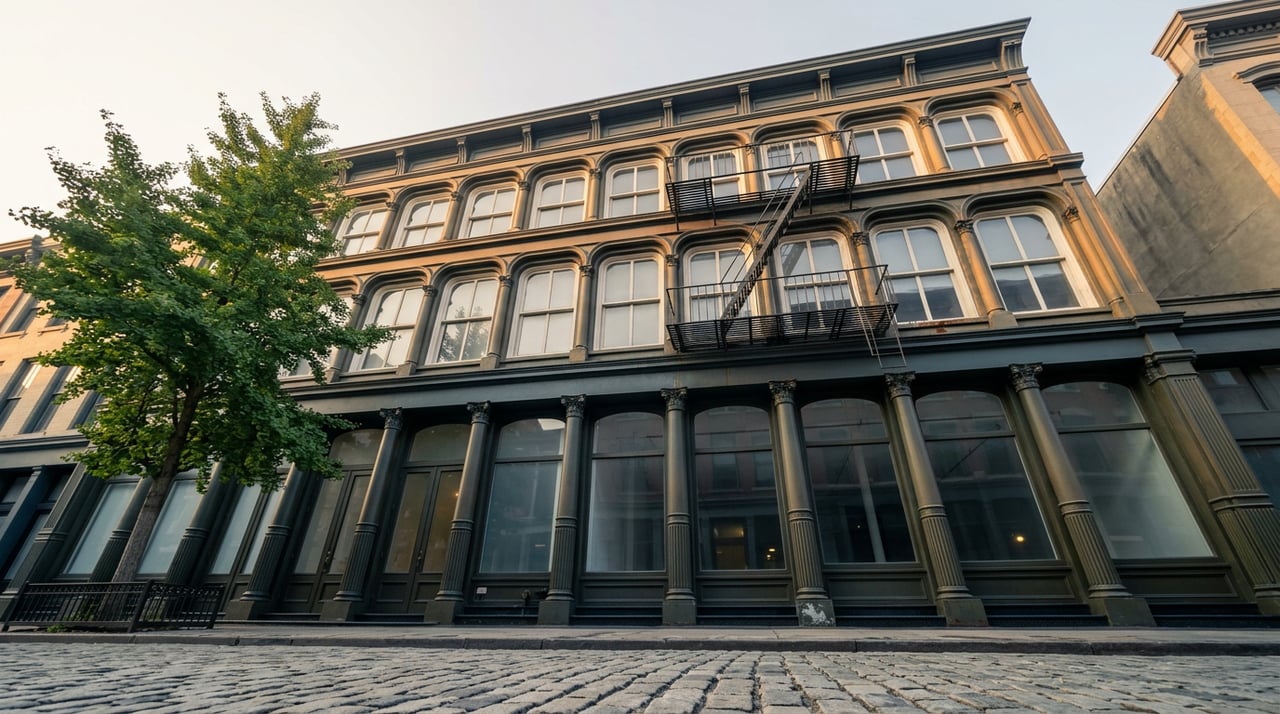
The date matters because it's specific and it's close, eleven days out from today. Garth Greenan Gallery's two new spaces at 10 Greene Street and 25 Greene Street open to the public on September 9, positioned directly across the street from one another inside landmarked, cast-iron facade buildings. The gallery says the layout is intentional: exhibitions in both spaces are meant to run in conversation, with visitors crossing the street mid-visit rather than finishing one show and leaving. The opening exhibitions are solo presentations by Rosalyn Drexler and Cannupa Hanska Luger, two artists the gallery has represented for years, arriving on the fifteenth anniversary of the gallery's founding.
That same week, a cluster of smaller SoHo and Tribeca galleries that quietly went dark for most of August come back online, on a rhythm that has nothing to do with any single gallery's calendar and everything to do with an industry-wide habit.
The block that never actually left
The part of the old SoHo gallery map that survived isn't on Broadway, where the standard walking tour and most of the neighborhood's retail attention now sits. It's a tight run of blocks along Walker, Lispenard and Franklin streets, bleeding into the Tribeca border, where a working gallery district has operated for years in relative quiet. Most of it closes for some stretch of August. All of it reopens within days of Labor Day:
- CANADA, at 60 Lispenard Street, closed its summer show on August 7 and lists its next exhibition, new work from Scott Reeder and Tyson Reeder, opening September 9 and running through October 17.
- Cristin Tierney Gallery, at 49 Walker Street, closed its summer exhibition August 7 and resumes regular Tuesday through Saturday hours on September 7.
- Ortuzar Projects, at 5 White Street, closed August 3 and reopens September 9, the identical date as Garth Greenan's SoHo debut.
- Kaufmann Repetto, at 55 Walker Street, closed intermittently across July and August, including a stretch from August 10 through August 24, with its summer show running through August 28.
None of these galleries coordinated with each other. The overlap exists because the art world treats the last weeks of August the way restaurants treat a slow Tuesday, and because Labor Day has functioned as an unofficial season opener for New York galleries for longer than any current SoHo resident has lived here. What's different this year is that a gallery is opening into that reset rather than just returning to it, which is why the date carries more weight than a typical calendar turnover.
Why this changes the walk, not just the map
None of this requires driving anywhere or planning around a single marquee show. The geography works because it's compact. Start on Walker or Lispenard when the smaller galleries open around eleven, work north through the Franklin Street cluster, and you're a ten-minute walk from Greene Street by the time Garth Greenan's two spaces are open for the afternoon. From there, Wooster and Prince is close enough that Manuela, the restaurant across from Hauser & Wirth's gallery, works as a natural stop rather than a destination requiring its own trip.
The other piece worth knowing about, even though it sits just east of SoHo proper, is the New Museum's expansion on the Bowery, which reopened in March after nearly a decade of construction. The addition doubled the museum's exhibition space and put a genuinely significant architectural project, designed by OMA in dialogue with the museum's original SANAA building, within about fifteen minutes on foot of most SoHo apartments. The museum's new ground-floor restaurant, run by chef Julia Sherman, gives residents a reason to treat a Bowery afternoon as an extension of a SoHo day rather than a separate outing.
None of this is a single big event you circle on a calendar once. It's a version of the neighborhood that was always partly here, on the blocks that don't front Broadway, now getting reinforced by a gallery willing to bet against thirty years of migration in the other direction. If you've lived here long enough to have internalized the version where SoHo lost its galleries for good, the week of September 7 is worth walking through in person before you decide that story still holds.
If you're weighing a move into SoHo or a nearby downtown neighborhood and want a read on how these shifts affect property values and demand, the team at Falchiere Group tracks these changes block by block. Schedule a Consultation to talk through what's actually happening on the ground before you make a decision based on a version of the neighborhood that's a few years out of date.