"I'm not sure what we'll do now," an 80-year-old artist who has lived in his SoHo loft since 1979 told a reporter in February, describing the moment New York's highest court ruled against him. If you've spent any time this year reading about SoHo real estate, you've probably seen some version of that story treated as a closed matter: the state's top court upheld the city's artist-loft conversion fee in January, the legal fight is over, move on. That framing is convenient and it is wrong, and if you have a contract on a SoHo loft right now, the gap between those two versions of the story is worth understanding before you close.
What actually happened in January, and what didn't
The case is Matter of Coalition for Fairness in Soho & Noho, Inc. v. City of New York, and it has been working through the courts since a group of longtime residents filed suit in February 2022. Their target was a fee tied to the city's 2021 SoHo-NoHo rezoning, which created a voluntary path for owners of artist-restricted lofts to convert those units to ordinary residential use by paying the city $100 per square foot into something called the Arts Fund. On a loft that frequently runs past 2,500 square feet, that fee lands around $250,000.
A state trial court sided with the city. The Appellate Division reversed that decision in December 2024, ruling the fee unconstitutional. Then, on January 13, 2026, the New York Court of Appeals reversed again, this time in the city's favor, in a 6-1 decision. That is the part that made headlines.
What most of those headlines left out is that the residents' attorneys, backed by Pacific Legal Foundation, have already petitioned the United States Supreme Court to take the case, with an amicus brief joining the Manhattan Institute, the National Association of Realtors, the New York State Association of Realtors, the National Association of Home Builders, and the National Apartment Association. Even the attorney who argued the case has said publicly that a favorable cert grant would push a final decision more than a year out. Nothing about the January ruling stopped the clock. It just changed whose move it is.
The mechanism that actually matters to a buyer
Here's the piece that gets lost in the legal back and forth: the Arts Fund fee only touches you if your specific loft still carries the JLWQA designation on its Certificate of Occupancy. Not every SoHo loft does, and treating the neighborhood as one undifferentiated pool of artist-restricted units is the single most common mistake I see buyers make before they've even opened escrow.
The designation dates to 1971, when the state created Joint Living-Work Quarters for Artists under Multiple Dwelling Law sections 275 through 278, giving a legal path for artists to live in the manufacturing lofts they'd already colonized. The catch was that only artists certified by the city's Department of Cultural Affairs could occupy the units legally. That certification system never really worked as designed. As of 2022, only 36 of the city's 1,636 JLWQA-designated units were actually occupied by a certified artist, and the city had certified fewer than 100 artists city-wide in the preceding decade. A 2022 amendment let existing non-artist occupants stay without becoming certified themselves, but that protection doesn't transfer. If a non-artist buys a JLWQA unit today, the law still requires converting it before that buyer can legally occupy or rent it out.
That is the real fork in the road, and it comes down to which of three buckets a given loft sits in.
| Status | Who governs it | What it means for financing and resale | Arts Fund exposure |
|---|---|---|---|
| JLWQA, unconverted | New York City zoning, Department of Cultural Affairs certification rules | Non-standard occupancy history can complicate underwriting; lenders may require a Temporary CO workaround | Full $100/sq ft fee due before conversion to standard residential |
| Loft Law IMD (Interim Multiple Dwelling) | NYC Loft Board, under the state's Article 7-C Loft Law | Legalization path exists outside the Arts Fund process entirely | None. Loft Law buildings are exempt from the SoHo-NoHo conversion fee |
| Fully converted, standard residential C of O | Standard DOB and lender rules apply | Trades like an ordinary condo or co-op | None. The conversion already happened |
The building at 158 Mercer Street is a useful stand-in for that third category. Built in the 1890s as an office building and later home to the New Museum of Contemporary Art before its move to the Bowery, it converted to a residential condominium in 1996, well ahead of the current dispute, and now trades on a clear residential Certificate of Occupancy with none of this baggage attached. That's the destination every JLWQA owner in the neighborhood is trying to reach. It's also proof the destination is reachable, if the paperwork gets done.
Not every legacy loft gets there cleanly. A NoHo loft with a lineage back to jazz musician Charles Mingus took a $100,000 price cut this summer, in a building still working through this exact question, though whether that specific cut traces to JLWQA status or simply a slow August is genuinely unclear from public reporting. That ambiguity is itself the point. Buyers can't tell from a listing description which bucket a building falls into. You have to pull the Certificate of Occupancy and, if the building is registered as an Interim Multiple Dwelling, confirm that with the Loft Board directly.
The waiting game has a cost, and it isn't yours to absorb passively
Here's where the thesis of "case closed" really breaks down. Several accounts of the fee describe it as indexed to rise on a set schedule, and Council Member Christopher Marte, whose district covers SoHo and NoHo, has publicly flagged further increases ahead. Meanwhile the city has made clear it wants the JLWQA program gone entirely, since new JLWQA designations have been prohibited since the December 2021 rezoning and the whole point of the Arts Fund path was to clear out the legacy units in favor of standard housing. So the fee that survived the Court of Appeals isn't a stable number you can plan around. It's a moving target attached to a program the city has already signaled it wants to retire, sitting under an unresolved cert petition that could reopen the entire question in more than a year, or never.
For a seller sitting on an unconverted JLWQA unit, that argues for resolving the status before listing rather than passing the uncertainty to a buyer. For a buyer under contract right now, it argues for treating the building's legal status as a closing condition, not a footnote.
What this means if you're circling a SoHo loft this fall
Before you get attached to a specific listing, get answers to three questions. Does the Certificate of Occupancy show JLWQA designation, completed conversion, or Loft Board IMD status? If it's JLWQA, has the seller or their attorney calculated the current Arts Fund cost at today's rate, and who is paying it? And has your lender confirmed in writing that it will underwrite a unit without a standard residential CO, or will you need a Temporary CO workaround that could slow your closing timeline?
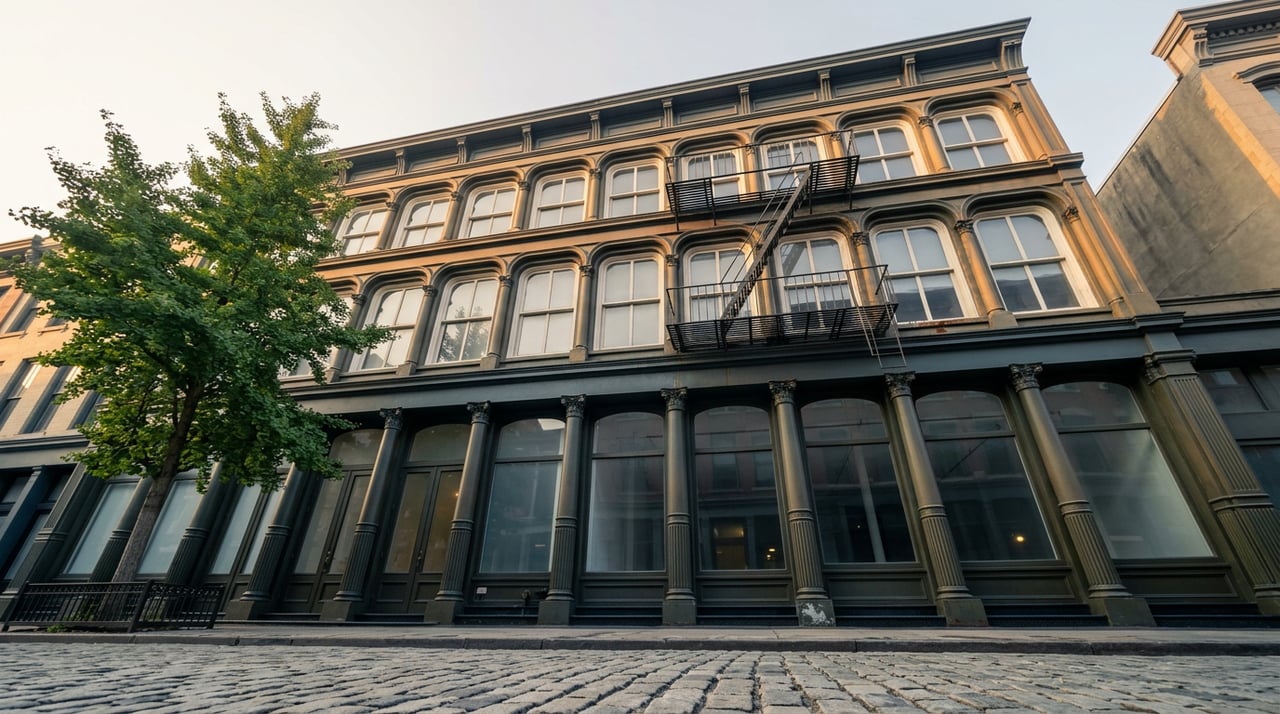
There's a second layer worth flagging separately. Most of SoHo also sits inside the SoHo-Cast Iron Historic District, designated in 1973 and expanded in 2010, which means the Landmarks Preservation Commission has a say over exterior changes regardless of what bucket the unit's occupancy status falls into. If your plans for the space include new windows, a storefront change, or anything visible from the street, that's a separate approval track layered on top of whatever JLWQA or Loft Law questions the building carries. None of this kills a good loft. It just means the diligence has to happen before the mortgage commitment, not after.
This is exactly the kind of transaction where having one team handle both the legal status review and the renovation planning pays off, because the answer to "can I convert this unit" and the answer to "can I renovate it the way I want" are often tangled together in the same set of city filings. At Falchiere Group, we walk buyers through both sides of that question before they sign, so the building's paperwork and your renovation plans get evaluated together instead of surprising you separately after closing.
A few direct answers
Do I have to be a certified artist to buy a SoHo loft in 2026? Only if the specific unit still carries an unconverted JLWQA designation and you plan to occupy it without paying the Arts Fund fee. Buildings that already completed conversion, or that were never JLWQA to begin with, carry no such requirement.
If the unit is in an Interim Multiple Dwelling, do I still owe the Arts Fund fee? No. Buildings legalized under the state's Loft Law as IMDs are governed by the NYC Loft Board and are exempt from the SoHo-NoHo Arts Fund conversion process entirely.
Does the Supreme Court taking the case change anything if I've already closed? Not retroactively for a fee already paid, but it's a real reason not to assume the current fee schedule is permanent if you're weighing whether to convert now or wait. The attorney who argued the case has said a decision, if the Court takes it at all, is more than a year out.
Ready to look at a specific SoHo building with someone who will pull the Certificate of Occupancy before you fall for the exposed brick? Schedule a Consultation with Falchiere Group.